Tampilkan postingan dengan label Yeghegis. Tampilkan semua postingan

Selasa, 28 Februari 2012

A Day in Armenia's Wine Country


A view of the Arpa River from the bridge in Areni
About an hour and a half south of Yerevan on the main road is the village of Areni.  You will know that you are approaching the village when the roadside stalls, usually reserved for fresh fruit, become displays of Coke and Fanta bottles that look suspiciously like they have something besides the advertised product inside.  Most of the bottles are, in fact, empty and only painted to look filled, but that little tidbit of information shouldn’t stop you from pulling over to sample what they are selling: wine and spirits made from local fruits. 

In 2007, archaeologists discovered a winery dating back over 6000 years in what is known as the Areni-1 cave.  It is the oldest winery ever discovered, predating any other by 1000 years.  (Also found in the Areni-1 cave is the world’s oldest leather shoe dating back over 5000 years.)  With so many years of practice behind them, it is easy to understand why Areni is the wine-making capital of Armenia. 

As you approach the village, on the left is a large, grey-stone building with a red roof.  This is the Areni wine factory and it is open to tours.  But most people prefer to sample the homemade products at the numerous stands along the side of the road.  Products on offer include grape, cherry and apricot wines as well as “vodka” (much more similar to grappa) made of the same fruits.  Some of these really pack a punch, so make sure you have a designated driver before you start tasting!


According to some, the reason for the Coke bottles is so that Iranian truck-drivers can bring the wine back with them across the border.  I think the explanation is much simpler: recycling.
Areni is a picturesque village complete with river views and a historic church, Surb Astvatsatsin, the stone carvings and architecture of which are attributed to Momik.  The best time to visit is the fall; there are many harvest festivals in early October and, of course, the Areni wine festival in mid-October.  The foliage is spectacular and the weather is still warm, plus there’s plenty of wine and kebab to sample.

If fall is the best time to visit Areni, winter is the best time to check out the village of Khachik.  Take the winding road through Areni up the mountain and hold your breath.  You will be amazed at the views of Ararat, which seems to hover above the snow and clouds.  When you reach the village, you won’t be able to escape the mountain.  It is simply magical.

One of many breathtaking views on the way up to Khachik.  The village school looks out on an equally impressive panorama.  Imagine trying to concentrate on lessons!
After you’ve spent the day wandering around Areni and Khachik, continue south for a nice khorovats.  There are several choices along the main road including one at the turn-off to Noravank and Lchak restaurant, situated on a pond.  If you feel like travelling a bit farther, there’s a great restaurant at Noravank as well.  But the best in the neighborhood is in Getap.  Continue south on the main road until you reach the turn off to Martuni.  Take that road to the second of two restaurants, Sisakanots, where they have excellent pork and fish khorovats.  In season, you can sit outside at a private table overlooking the Yeghegis River.

Private dining in style at Lchak restaurant
 
Rebecca is an American Peace Corps volunteer who lives and works in Vayots Dzor marz. The views and opinions expressed are hers and do 
not necessarily reflect those of the U.S. Peace Corps. 


Read more posts from Rebecca: 

Selasa, 31 Januari 2012

Rediscovering a Lost Community in Vayots Dzor


Late August sunset over a family plot at the medieval Jewish cemetery in Yeghegis
Driving south from Yerevan, after you pass Areni (of wine and cave fame) and Noravank, you reach the turn-off to the Selim Pass which leads to Martuni.  Not far up the road is the village of Shatin.  Take the turn into the village and follow the road which will bring you to Yeghegis.


Today, Yeghegis is a village of about 500 people. The houses look like they have sprung out of the landscape and may have been there forever.   Until 1994, it was an Azeri enclave known as Alayaz.  Sometimes, if you stop and ask a local, they will direct you to the village of Artabuynk, which also used to be called Yeghegis.  It’s a little confusing, but you are looking for the present day village of Yeghegis – the medieval capital of the Kingdom of Syunik.  Looking at it, it’s hard to imagine that it was once a capital city of 10,000 inhabitants.  What is even more amazing, though, is the makeup of that population.

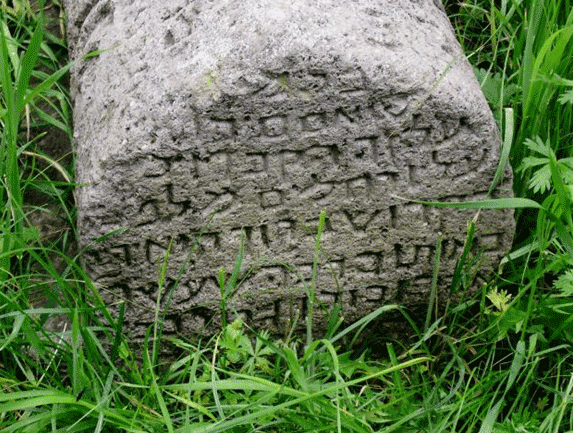
In 1996, quite by accident, the local bishop spotted some very old looking tombstones in the Yeghegis River.  He searched the area and found more, some with inscriptions in an alphabet he did not recognize.  Imagine his shock to discover that the alphabet was Hebrew!  Fast forward a few years and seasons of excavations and an entire Jewish cemetery has been unearthed.

Geometric shapes on a tombstone at the Orbelian kings'
graveyard at the entrance to Yeghegis village.
Armenia today is 98% Armenian.  99% of the population is also Christian- the vast majority of them belonging to the Armenian Apostolic Church.  But here, in Yeghegis, 800 years ago, there was a thriving multiethnic society which included a previously unknown, and by all accounts prosperous, Jewish community.

The tombstones at the cemetery are quite large and come from the same quarry where the ruling Orbelian kings purchased their tombstones.  They would have been very expensive to make and transport.  They also bear markings similar to those on the kings' tombstones and undoubtedly came from the same workshop.

Geometric shapes on a tombstone found at the Jewish
cemetery. The stones came from the same quarry and
were engraved at the same workshop.
In addition to the cemetery, researchers discovered an inscription on nearby Spitakavor church which indicated that the land on which the church was built had been ultimately purchased from a Jewish person.  This one fact, in and of itself, sets the Jewish community of Yeghegis apart from their European cousins who were prohibited from owning land.

What became of the Jewish community?  We can only guess.  After the fall of the Mongol Empire, the Orbelian kings lost their privileged standing.  The population of the capital, which they had moved off the main trading routes of the Silk Road, dwindled.  The Jewish inhabitants probably just moved on as the other inhabitants did.  It is hoped that, with further excavations in the area, more will be discovered about this fascinating place.  Until then, we can only let our imagination wander.

Engravings on a young boy’s tombstone in Yeghegis.  This stone has Hebrew engravings on 3 sides.  It also features     eternity wheels which were engraved by a skilled Armenian craftsman before the Hebrew inscriptions were added.  It was found after excavation of a nearby watermill where it was in secondary use as flooring for the mill.
Rebecca is an American Peace Corps Volunteer who lives and works in Vayots Dzor Marz. The views and opinions expressed are hers and do not necessarily reflect those of the U.S. Peace Corps. 


Read more posts from Rebecca:
Ghosts of the Pasts in Vayots Dzor